
Concrete Calculator: Yards, Bags and Cost for Any Pour
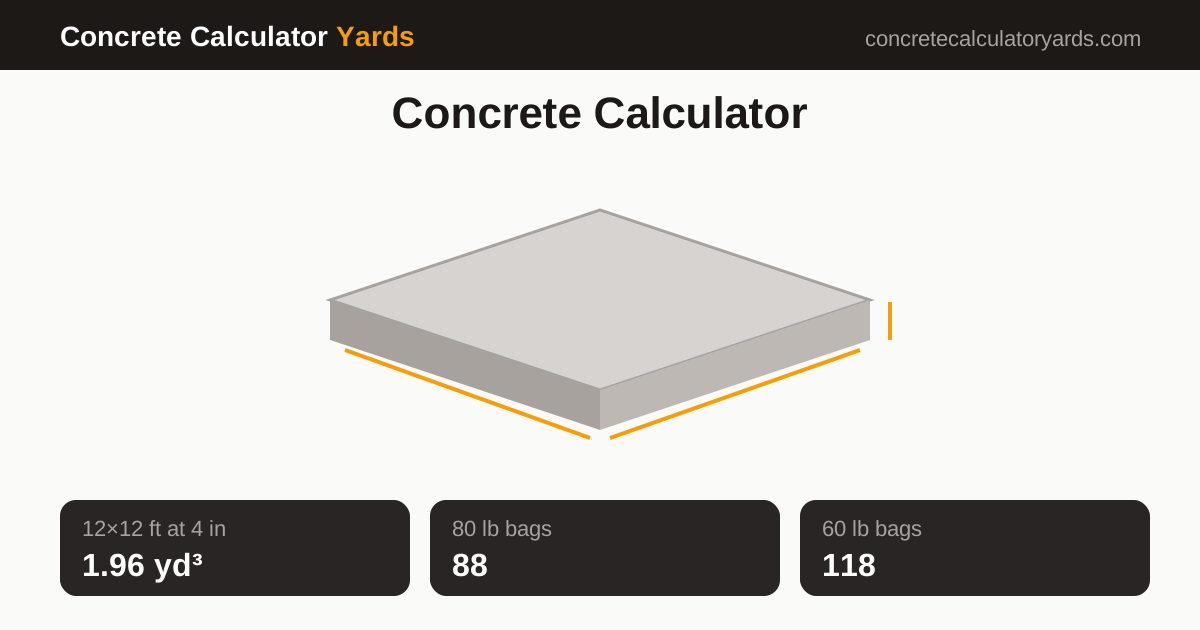
A 12×12 ft slab at 4 in needs 1.78 cubic yards of concrete, or 1.96 yd³ with 10% extra, which is 88 bags of 80 lb mix.
Advanced options: waste, prices
NRMCA advises ordering 4 to 10 percent over the estimate.
Concrete needed (with 10% extra)
1.96 yd³
1.50 m³ · 48 ft³ before extra
Slab: 12 ft × 12 ft × 4 in. Over about 1 yd³: order ready-mix.
Premix bags
- 80 lb88
- 60 lb118
- 50 lb141
- 40 lb176
- Ready-mix cost
- $313
- Weight
- 7,200 lb
Full breakdown
| Volume before extra | 1.78 yd³ · 1.36 m³ |
|---|---|
| With 10% extra | 1.96 yd³ |
| Weight (150 lb/ft³) | 7,200 lb · 3.60 tons |
| Pallets of 40 lb (80 bags each) | 3 |
| Pallets of 60 lb (56 bags each) | 3 |
| Pallets of 80 lb (42 bags each) | 3 |
| Truckloads at 12 yd³ | 1 |
| Truckloads at 8 yd³ | 1 |
Bag counts round up, as Quikrete's own calculator does. Cost uses your prices; delivery and short-load fees are extra.
Key takeaways
- Concrete volume = length × width × thickness in feet ÷ 27 = cubic yards.
- Add 4 to 10 percent for waste (NRMCA); this calculator adds 10%.
- One cubic yard = 45 bags of 80 lb mix or 60 bags of 60 lb (Quikrete yields).
- Above about 1 cubic yard, ready-mix at $160–195 per yard usually beats bags.
- Slabs on the ground must be at least 3½ in thick (2021 IRC); 4 in is standard for patios and car driveways.
How Much Concrete Do I Need?
You need the volume of your pour in cubic yards, plus extra for waste. Multiply length × width × thickness in feet, divide by 27, then add 10%. A 12×12 ft slab 4 in thick holds 48 ft³, which is 1.78 yd³ (1.36 m³); with 10% extra, order 1.96 yd³, or 88 bags of 80 lb mix.
The calculator above does this for ten shapes, converts imperial and metric units, and lets you add several parts, such as a slab plus its footings, into one total.
Worked Examples: Slab, Footing and Sonotube
Three common pours, worked step by step with the calculator's own numbers, show how each shape is measured.
Example 1, a 10×10 ft patio slab at 4 in. 10 × 10 × (4 ÷ 12) = 33.33 ft³. 33.33 ÷ 27 = 1.23 yd³. With 10% extra: 1.36 yd³, which is 62 bags of 80 lb mix or 82 bags of 60 lb.
Example 2, a 20 ft wall footing 12 in wide and 6 in deep. 20 × (12 ÷ 12) × (6 ÷ 12) = 10 ft³ = 0.37 yd³. With 10% extra: 0.41 yd³, or 19 bags of 80 lb mix.
Example 3, a 12 in sonotube 4 ft deep. 3.1416 × 0.5² × 4 = 3.14 ft³. With 10% extra: 6 bags of 80 lb mix per tube.
Concrete Needed for Common Projects
The table lists concrete for common projects, with 10% extra and bag counts rounded up.
| Project | yd³ with 10% | 80 lb bags | 60 lb bags | Ready-mix trucks (12 yd³) |
|---|---|---|---|---|
| 8×8 ft pad, 4 in | 0.87 | 40 | 53 | bags |
| 10×10 ft slab, 4 in | 1.36 | 62 | 82 | 1 |
| 12×12 ft slab, 4 in | 1.96 | 88 | 118 | 1 |
| 20×20 ft slab, 4 in | 5.43 | 245 | 326 | 1 |
| 24×24 ft garage, 4 in | 7.82 | 352 | 470 | 1 |
| 4×4 fence post, 2 ft hole | 0.06 | 3 | 4 | bags |
| 12 in sonotube, 4 ft | 0.13 | 6 | 8 | bags |
| 3 steps, 4 ft wide | 0.52 | 24 | 32 | bags |
Every slab size from 8×8 to 40×60 ft is on the slab sizes table.
How to Calculate Concrete
Calculate concrete in five steps.
- Measure length and width in feet.
- Convert thickness from inches to feet by dividing by 12.
- Multiply length × width × thickness to get cubic feet.
- Divide cubic feet by 27 to get cubic yards.
- Add 10% for waste.
Cubic yards = Length (ft) × Width (ft) × (Thickness (in) ÷ 12) ÷ 27
Metric: m³ = Length (m) × Width (m) × Thickness (m)
Our full guide on how to calculate concrete covers every shape and the most common mistakes.
Why Divide by 27?
You divide by 27 because one cubic yard is 3 ft × 3 ft × 3 ft = 27 cubic feet, and ready-mix is sold by the cubic yard. One cubic yard equals 0.7646 m³ (NIST SP 811).
How Much Will 1 Yard of Concrete Pour?
One cubic yard pours 81 sq ft at 4 in thick, such as a 9×9 ft slab, or 54 sq ft at 6 in. More coverage figures are on cubic yards of concrete.
Concrete Formulas for Every Shape
Each shape has its own volume formula; the calculator applies them automatically.
| Shape | Formula (cubic feet) | Calculator |
|---|---|---|
| Slab, pad, patio | L × W × T | Concrete slab calculator |
| Strip footing | L × W × D | Concrete footing calculator |
| Round tube or pier | 3.1416 × r² × H | Sonotube calculator |
| Post hole | (hole area − post area) × depth | Fence post concrete calculator |
| Steps | W × tread × riser × n(n+1) ÷ 2 | Concrete steps calculator |
| Wall | (L × H − openings) × T | Concrete wall calculator |
| Circle slab | 3.1416 × r² × T | Circular slab calculator |
| Triangle | ½ × base × height × T | Triangle calculator |
Bags or Ready-Mix Concrete?
Bags suit pours up to about 1 cubic yard, and ready-mix suits anything larger; the 1 yd³ switch is this calculator's own rule. A cubic yard takes 45 bags of 80 lb mix, which is 3,600 lb to lift and mix by hand, while a ready-mix truck delivers 8 to 12 yd³ at once (NRMCA).
| Bag size | Yield (ft³) | Bags per cubic yard |
|---|---|---|
| 80 lb | 0.6 | 45 |
| 60 lb | 0.45 | 60 |
| 50 lb | 0.375 | 72 |
| 40 lb | 0.3 | 90 |
Compare the real cost with your prices on bagged concrete vs ready-mix, or count bags with the concrete bag calculator.
How Much Does Concrete Cost?
Ready-mix concrete costs $160 to $195 per cubic yard, and a poured slab costs $6.50 to $10.50 per square foot installed, according to Concrete Network's national range. A 20×20 ft slab at 4 in costs $869–$1,059 in concrete and about $2,600–$4,200 installed.
Price changes with mix strength, order size and delivery distance; enter your own price in the calculator's advanced options. See the concrete cost calculator and concrete slab cost pages.
How Much Does Concrete Weigh?
Normal-weight concrete weighs 140 to 155 lb per cubic foot, typically 145 lb/ft³ (FHWA). This calculator uses 150 lb/ft³, which is 4,050 lb per cubic yard and about 2,403 kg/m³. A 12×12 ft slab at 4 in weighs about 7,200 lb. See the concrete weight calculator.
How Thick Should Concrete Be?
A slab on the ground must be at least 3½ in (89 mm) thick under the 2021 IRC (R506.1); 4 in is standard for patios, sheds and car driveways, and 5 to 6 in is used for trucks and RVs (Concrete Network). Footings must be at least 12 in wide and 6 in deep (IRC R403.1.1).
Each extra inch adds 25% to a 4 in slab's concrete. The full chart is in our guide on how thick a concrete slab should be.
How Much Extra Concrete Should You Order?
Order 4 to 10 percent more than the estimate, as NRMCA advises; this calculator adds 10% by default and lets you set 0 to 15%. A slab poured 1/8 in thicker than a 4 in plan uses 3 percent more concrete, and hardened concrete is about 2 percent smaller than fresh (NRMCA CIP 8), so a thin margin runs out fast.
Concrete Mix Ratio and Strength
A standard hand mix is 1 part cement, 2 parts sand and 3 parts gravel by volume (Quikrete). Residential concrete needs 2,500 to 3,500 psi depending on use and climate (2021 IRC Table R402.2), and most bagged concrete mixes are rated at 4,000 psi. See the concrete mix ratio calculator and the concrete PSI guide.
How Long Does Concrete Take to Cure?
Concrete should be kept moist and above 50 °F for 3 to 7 days (NRMCA). You can walk on a new slab after about 24 hours, drive a car on it after 7 days and park heavy vehicles after 28 days (Concrete Network). Details are in concrete curing time.
Do You Need Gravel or Rebar Under a Slab?
House slabs below grade need a 4 in base course of gravel, crushed stone or sand under the 2021 IRC (R506.2.2), unless the soil is well-drained Group I soil. Rebar in slabs-on-ground is optional under the same code (R506.2.4). See gravel under a concrete slab and the rebar calculator.
Which Concrete Calculator Do You Need?
Pick the calculator that matches your project; all of them use the same tested engine.
- Slabs, patios and pads: concrete slab calculator, monolithic slab calculator, circular slab calculator.
- Driveways: concrete driveway calculator with yards and cost by size.
- Footings and posts: concrete footing calculator, deck footing calculator, sonotube calculator, fence post concrete calculator.
- Walls and steps: concrete wall calculator, retaining wall calculator, concrete steps calculator, curb and gutter calculator.
- Bags, yards and trucks: concrete bag calculator, bags of concrete per yard, cubic yards of concrete, concrete truck calculator.
- Cost and materials: concrete cost calculator, concrete mix ratio, cement calculator, concrete block calculator.
Every tool is listed with a one-line summary on the all concrete calculators page, and the concrete guides explain the numbers behind them.
Tips for an Accurate Concrete Estimate
Five habits keep a concrete order from coming up short.
- Measure the forms, not the plan: check depth at several points, because the subgrade is rarely flat.
- Convert inches before multiplying: 4 in is 0.333 ft.
- Split odd shapes into rectangles, circles and triangles, and add them as parts.
- Add the waste allowance of 4 to 10 percent (NRMCA).
- Re-check before the last truck and tell the producer, as NRMCA advises, to avoid short loads.
How This Concrete Calculator Works
Every shape is converted to cubic feet, then to cubic yards (÷ 27) and cubic meters (NIST). Bag counts use Quikrete's yields and always round up. The 10% extra, 150 lb/ft³ density and the switch to ready-mix at about 1 yd³ are this calculator's own rules; every number is tested before release. Details are on how we calculate and our sources page.
Concrete Calculator FAQ
How much concrete do I need for a 10×10 slab?
A 10×10 ft slab at 4 in needs 1.23 cubic yards of concrete, or 1.36 yd³ with 10% extra, which is 62 bags of 80 lb mix.
How many 80 lb bags of concrete make a cubic yard?
45 bags of 80 lb concrete make one cubic yard (27 ft³), because each bag yields 0.6 ft³; with 10% extra, buy 50.
How many bags of concrete for a 20×20 slab?
A 20×20 ft slab at 4 in needs 245 bags of 80 lb concrete with 10% extra, so ready-mix (5.43 yd³, one truck) is the better choice.
How many yards of concrete for a 24×24 slab at 4 inches?
A 24×24 ft slab at 4 in needs 7.11 cubic yards, or 7.82 yd³ with 10% extra.
How much is a yard of concrete?
A cubic yard of ready-mix concrete costs $160 to $195 in Concrete Network's national range; delivery and short-load fees are extra.
How much does a yard of concrete weigh?
A cubic yard of concrete weighs about 4,050 lb at 150 lb/ft³, or 3,915 lb at FHWA's typical 145 lb/ft³.
Is a yard of concrete the same as a cubic yard?
Yes, a yard of concrete always means one cubic yard, which is 27 cubic feet or 0.7646 m³.
Should I use bags or ready-mix concrete?
Use bags up to about 1 cubic yard and ready-mix above it; one cubic yard is already 45 bags of 80 lb mix.
What is the standard concrete mix ratio?
The standard hand-mix ratio is 1 part cement, 2 parts sand and 3 parts gravel by volume, according to Quikrete.
Does a 4-inch concrete slab need rebar?
No, the 2021 IRC treats reinforcement in slabs-on-ground as optional; where used, it sits between the center and the upper third of the slab.
Do I need gravel under a concrete slab?
Yes for house slabs below grade: the 2021 IRC requires a 4 in base course, except on well-drained Group I soils.
How accurate is this concrete calculator?
The math is exact for the sizes you enter; real orders vary with uneven subgrade and form movement, which is why the calculator adds 10% extra.
Next step
Enter your measurements in the calculator above, then open the page for your project, such as the concrete slab calculator or the fence post concrete calculator, for shape-specific tables and code minimums. Before you order, read how to order ready-mix concrete.
Official sources
- Quikrete concrete calculator (bag yields)
- NRMCA CIP 8: Discrepancies in Yield
- NRMCA CIP 31: Ordering Ready Mixed Concrete
- NRMCA CIP 11: Curing In-Place Concrete
- 2021 International Residential Code, Chapter 4 (foundations, concrete strength)
- 2021 International Residential Code, Chapter 5 (slabs, decks)
- NIST SP 811, Appendix B (unit conversions)
- FHWA Lightweight Concrete primer (density)
- Concrete Network: concrete prices
Last reviewed 2026-11-05. Numbers come from our tested engine; see how we calculate and our sources.